
2025
Live and Virtual Outreach
Greenlathe Collaborative: A Solarpunk Collective
On December 18, 2025, Public Invention hosted an Inventors Gathering where Andrea Renshaw of Greenlathe Collective presented the nonprofit's mission and its solarpunk values.
Co-hosted Towards Distributed Quality Management: Show & Tell Webinar
On December 3-4, 2025, Public Invention co-hosted an international, (fully) virtual conference offering free seminars on distributed quality management concepts across 2 days.
Check here for some available recordings!
Solarpunk Healthcare Free Virtual Conference
On November 8, 2025, Public Invention partnered with Greenlathe Collective to host presentations about healthtech, community action, and healthcare-focused makerspaces. Victoria Jaqua presented the Global Distributed Tracking (GDT) project, and Avinash Baskaran from the Librecorder team discussed the medical hardware ecosystem.
Live Demo Day
On June 15, 2025, Public Invention held a live Demo Day in the Austin Central Library with presentations from three project teams.
2024
Publications and Presentations
On October 24, 2024, the NASA-MCOG Team Helped KidsOR
Public Invention built part of a revolutionary oxygen concentrator in conjunction with NASA and American Oxygen, which was tested for 9 months in Zambia and Scotland in 2025. Check out their efforts with KidsOR.
On October 22, 2024, the OSH Registry was Published in IEEE GHTC 2024
Our OSH Registry project team, a group developing a registry of Open Source Hardware (OSH) projects, was published in the IEEE Global Humanitarian Technology Conference (GHTC) 2024.
On September 28, 2024, the GPAD Project Team Published a Paper in HardwareX
Public Invention's GPAD Team published a paper on their "General Purpose Alarm Device: A programmable annunciator" in HardwareX.
On August 15, 2024, for the August Inventor Gathering, Invention Coach Christina Cole and Public Inventor Prajwal Shah presented the NanoCapTable Project. Check out the recording on YouTube.
On June 1, 2024, there was a new NASA contract
Our contract with NASA got extended so our Ceramic Oxygen Generator Project team could work to improve the controller. They hoped to refine the controller monitoring critical engineering parameters, like heat and temperature, within the oxygen generating source developed in conjunction with NASA and American Oxygen.
On April 18, 2024, the PolyVent Arrived at Colorado Mesa University
Robert L. Read traveled to Colorado to introduce and deliver the PolyVent Educational Platform to Dr. Michelle Mellenthin and Talles Santos from Colorado Mesa University's Electrical Engineering Program. This was also the same day as our virtual inventor gathering. That evening, we heard from Dr. Mellenthin and Professor Santos on their research in pulmonology and electrical impedance tomography (EIT) while Public Invention Founder Robert Read, presented briefly on the PolyVent.
On March 19, 2024, Robert L. Read's co-authored paper was published in the Operations Research Forum: Maximizing Supply Chain Resilience: Viability of a Distributed Manufacturing Network Platform Using the Open Knowledge Resilience Framework
2023
NASA Contracts Extended and FOSDEM
In June 2023, Public Invention attended the American Society for Engineering Education Conference and presented a paper about the PolyVent. The paper was accepted to the American Society for Engineering Education.
Finished 2nd NASA Contract
In October 2023, the 2nd NASA contracted project ended.
Public Invention Presented Two Talks at FOSDEM
In February 2023, we presented a talk on the PolyVent at FOSDEM and introduced the GOSQAS project. The Global Open Source Quality Assurance System was an alliance of many humanitarian engineering non-profits which proposed to improve quality assurance. They built a free and open asset and provenance tracking system.
Second NASA Contract
In early January, 2023, Public Invention received a second contract from NASA to design and build a digital control system for an advanced solid-state oxygen concentrator. (We only made the control system, not the ceramics and the chemistry.) This has huge implications for global health, and we are proud to have been a part of it.
2022
Papers, Contracts, and Project Testing
PolyVent Educational Platform Tested at Rice University
In early December 2022, the PolyVent Educational Platform was used in an extra credit class exercise by senior biomedical engineering students at Rice University, who gave it high marks.
NASA Contract
In the summer of 2022, NASA awarded a sub-contract to Public Invention through Jacobs' Engineering for advice on building a control system for a Ceramic Oxygen Generator. This work was closely related to work we had already done on "The Ox" oxygen generator and the PolyVent/VentOS system. See the system here.
Journal Paper Published
In July 2022, work began during the Public Invention Mathathon of 2018 was finally culminated! Read, Robert L. "Calculating the Segmented Helix Formed by Repetitions of Identical Subunits thereby Generating a Zoo of Platonic Helices." Mathematics 10.14 (2022): 2533.
Ferrofluid Paper Released
On March 30, 2022, Veronica Stuckey and Robert L. Read released a pre-print research paper called, "A Novel Passive Ferrofluid One-way (Check) Valve," on Engineering Archive (EngrXIV): Link Here!
2021
Open Source Conferences

Paper Published
In November, 2021, along with Dr. Erich Schulz and Ben Coombs, we published a summary of the "Open-source hardware and the great ventilator rush of 2020".
Paper Presented
On September 8, 2021, Robert L. Read presented a paper at the 2nd IMA conference on Robotics and Mathematics entitled "Calculating the Segmented Helix Formed by Repetitions of Identical Subunits". This work came out of the 2018 Public Invention Mathathon.
RespiCon
On May 28, 2021, Public Invention hosted RespiCon, a virtual conference on open source respiration policy and technology. 115 people attended, and many valuable connections formed.
On January 9, 2021, Public Invention hosted a conference called PubInvCon 2021: Work to be Done! The conference was a gathering of dedicated inventors, volunteers, scientists, students, and those interested in humanitarian inventing “in the public, for the public.” We discussed the successes of 2020, and outlined the hard work still to be done in 2021.
2020
The Pandemic and the Open Source Response

On November 7-8, 2020, Dr. Robert Read delivered a paper coauthored by Avinash Baskaran to the ICMME 2020: the 7th International Conference on Mechatronics and Mechanical Engineering.
On October 20, 2020, Public Invention was part of a successful demo of the PolyVent, presented to the Mayor of Linz, Austria.
In July 2020, we hosted a VentCon QA, a free, virtual mini-conference that discussed open source ventilator Quality Assurance and Regulatory Compliance. This conference was again supported by Helpful Engineering and Make.co.
In May 2020, Public Invention hosted Vent-Con 2020, a conference about Open Source Ventilators. Make Magazine, Helpful Engineering, and the Ventilators Collaboration Network co-hosted the event. The conference was a big success, with about 120 participants in attendance.
Avinash Baskaran, Megan Cadena, and Keeshan Patel made an accepted proposal of a "soft Stewart platform" to the UT Create-a-thon https://www.facebook.com/groups/utcreateathon/
Avinash Baskaran Won 1st Place in IEEE Professional Forum in Clear Lake, TX.
By this point, we had produced 26 open-source repos of work.
We revitalized the Tetrobot concept.
2019
New Projects and a New Board
On October 16, 2019, Avinash Baskaran and Megan Cadena traveled to the IEEE Professional Forum and Students’ Poster Session at the University of Houston-Clear Lake to preset posters. Avinash got the highest score and won a $100 prize.
On April 16, 2019, Avinash Baskaran agreed to work on Project #48: Gluss Controller, which was a part of Project #16: Tetrobots.
On April 15 2019, David Jeschke contributed Project #47: Euler Notebook, which was fairly well-developed in terms of code.
On March 14, 2019, Annalee Flower Horne contributed ideas to Project #40: Oil Painting Wheel.
On February 15, 2019, Adam Riggs, Martin Smith, Keeshan Patel, Kaitlin Devine, Nina Bianchi, Lea Shanley, John Gibbons, Stephanie Liu, and Marc Jones became the first official board members of Public Invention, along with President Robert L. Read.
On February 1, 2019, Robert Gatliff began contributing his work on Platonic solids to Project #45: Segmented Helices.
On January 1, 2019, Mark Frazier contributed the basic idea of Project #44: Social Tetrahedrons.
2018
Collaboration and SXSW
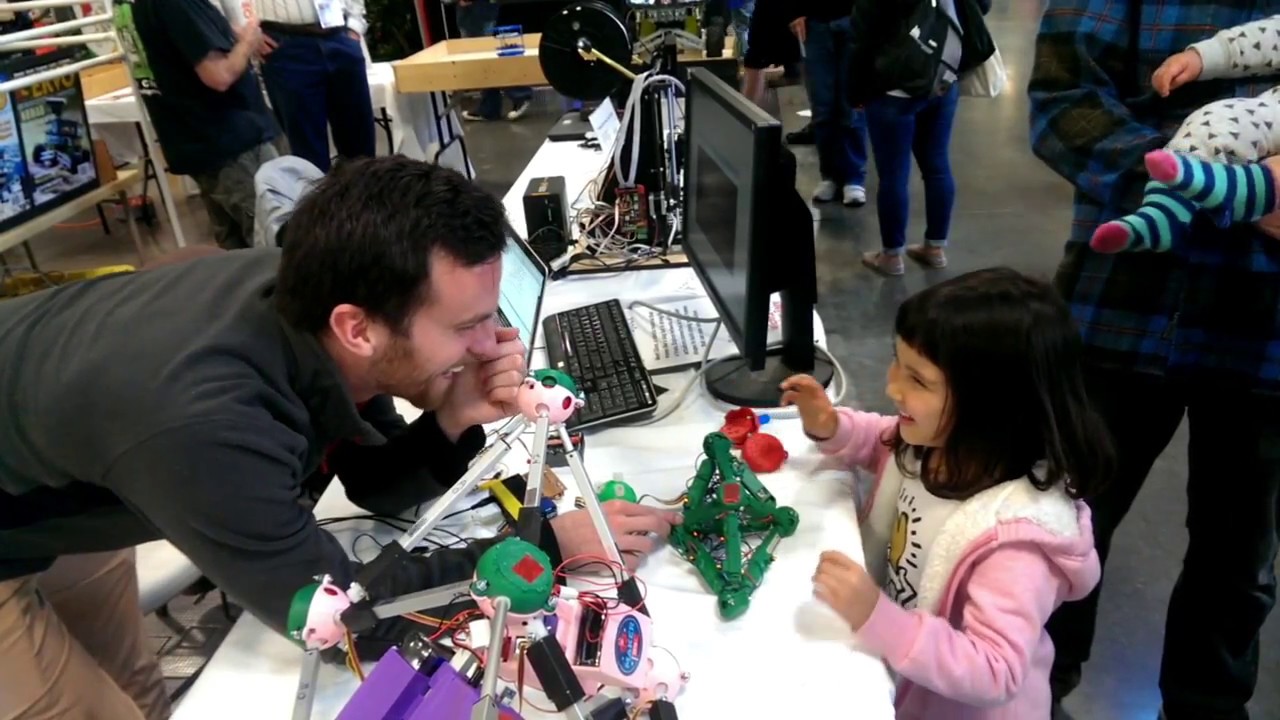
On December 1, 2018, David Jeschke, Nathan Gilbert, and others contribute to the first ever Public Invention Mathathon.
In October 2018, The American Society of Mechanical Engineers published a peer-reviewed academic journal article describing Robert Read's optimization of a tetrahelix.
In conjunction with the Greater Austin Chapter of Engineers Without Borders USA, Public Invention invented the Armadillo, a portable Petrifilm Incubator.
On August 1, 2018, Neil Martis assisted in the creation and programming of the geotagtext project, which grew out of Project #1: the “Little Free Library” mobile app.
In May 2018, Rob Read published an article about the Raspberry Pi in Nuts and Volts (with Morgan Chen).
On January 1, 2018, Joshua Hannan significantly contributed to the Gluss Controller Project, including Raspberry Pi python code which was used at SXSW Create.
2016 - 2017
Turret Joint, Pendulum Simulation, and Optical Sensor
During 2017 and 2018, Rob Read developed a 3D printable optical linear sensor with Keeshan Patel. The project closed in August, 2018.
On October 1, 2017, Evan Bartilson and Joshua Hannan designed the 3D printing needed to make the gluss controller in the Gluss Controller Project.
In 2016, Robert Read created an educational double pendulum simulation as part of an unsolicited proposal to Montshire Science Museum for a physical exhibit.
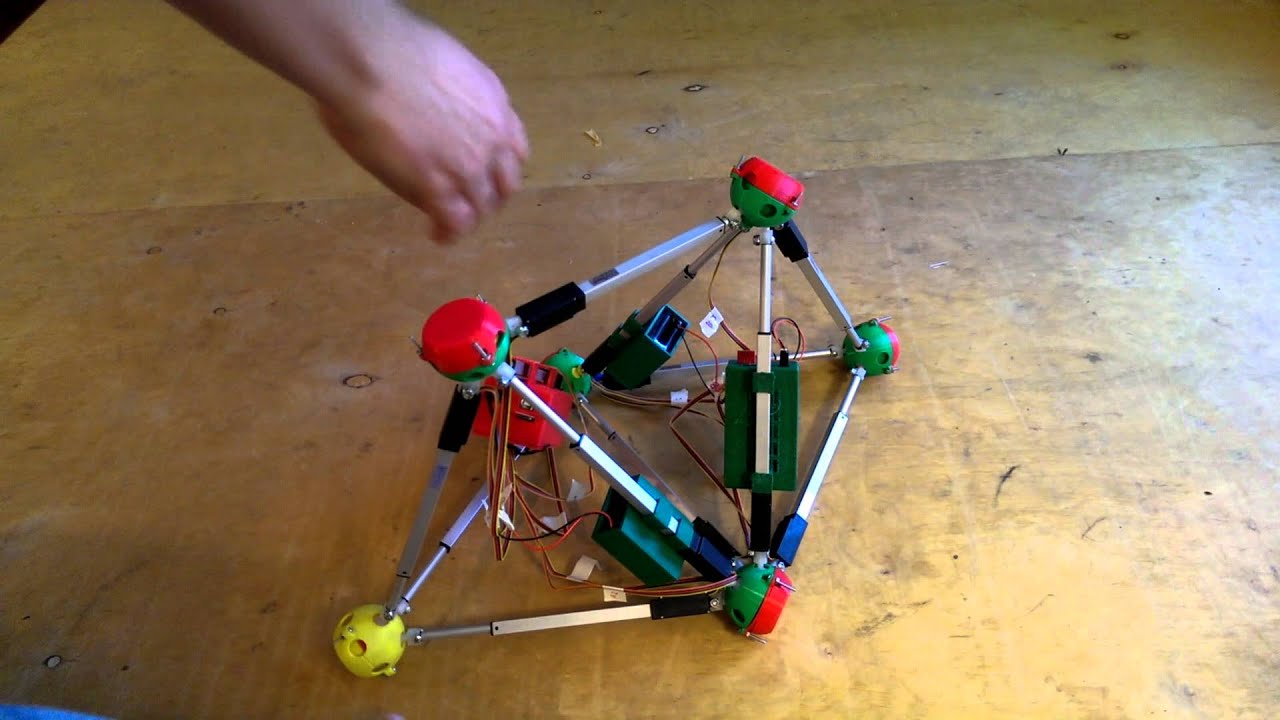
During 2015 and 2016, we published 3D plans for a legitimately novel invention: the Turret Joint which was essential to the construction of Gluss robots (invented by Song, Kwon, and Kim).
2015
The Beginning
Begun in August, 2015, the Gluss Project demonstrated a very novel, unconventional robot.
In 2015, the Gluss Pusher project developed an inexpensive prototype linear actuator for building large, highly scalable robots.
In fall of 2015, we created and published CoilChoice, an interactive tool for designing electromagnetic coils.
This project later took 4th place in the Women in Technology Institute (WITI) Virtual Hackathon.
In 2015, a team formed at the Austin Hack for Change Civic Hackathon won “Most Hacked Forward” superlative with ATX Preemie Warmer.